Tuesday, 1 March 2016

Strength of Materials

About the Subject:

Strength of materials, also called mechanics of materials, is a subject which deals with the behavior of solid objects subject to stresses and strains. To understand the stresses developed in bars, compounds bars, beams, shafts, cylinders and spheres. 
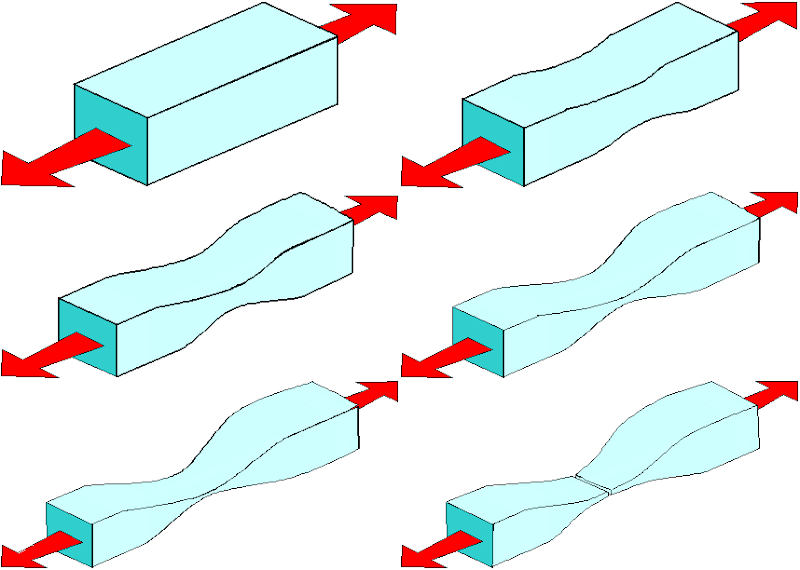


Topics to be covered in this Seminar:

Rigid bodies and deformable solids – Tension, Compression and Shear Stresses - Beams – types transverse loading on beams – Shear force and bending moment in beams – Cantilevers - Torsion formulation stresses and deformation in circular and hollows shafts - Double Integration method – Macaulay’s method - Stresses in thin cylindrical shell due to internal pressure circumferential and longitudinal stresses and deformation in thin and thick cylinders

Time to be planned :

     
1 or 2 days

Kind of program :

       3D based Seminar and Guest Lecture for the Students

Reason for the program :

      Kalam Scientist Team aiming to build young generation Scientist


Sample Clips for Reference :


                                                 Shear force and bending in Beams                                                

Cheers,
Kalam Scientist Team
7667668009
7667662428


Engineering Materials and Metallurgy

About the Subject:

It deals with imparting knowledge on the structure, properties, treatment, testing and applications of metals and non-metallic materials so as to identify and select suitable materials for various engineering applications. Materials must perform their tasks in an economical and societally responsible manner. Understanding the relationships between properties, structure, processing and performance makes the Materials Engineer the master of the engineering universe. Metallurgy is a domain of materials science and engineering that studies the physical and chemical behavior of metallic elements, their intermetallic compounds, and their mixtures, which are called alloys.


Topics to be covered in this Seminar:

Constitution of alloys – Solid solutions, substitutional and interstitial - Full annealing, stress relief, recrystallisation and spheroidising – normalising, hardening and Tempering of steel - 6 Effect of alloying additions on steel- α and β stabilisers– stainless and tool steels – HSLA, Maraging steels - Polymers – types of polymer, commodity and engineering polymers – Properties and applications of various thermosetting and thermoplastic polymers - Mechanisms of plastic deformation, slip and twinning – Types of fracture – Testing of materials under tension, compression and shear loads

Time to be planned :

     
1 or 2 days

Kind of program :

       3D based Seminar and Guest Lecture for the Students

Reason for the program :

      Kalam Scientist Team aiming to build young generation Scientist


Sample Clips for Reference :


                                          Hardening and Tempering of Steel


Cheers,
Kalam Scientist Team
7667668009
7667662428


Applied Thermodynamics and Heat Transfer

About the Subject:

Applied thermodynamics is the science of the relationship between heat, work, and systems that analyze energy processes. The energy processes that convert heat energy from available sources such as chemical fuels into mechanical work are the major concern of this science. Thermodynamics consists of a number of analytical and theoretical methods which may be applied to machines for energy conversion.Heat transfer is the exchange of thermal energy between physical systems. The rate of heat transfer is dependent on the temperatures of the systems and the properties of the intervening medium through which the heat is transferred. The three fundamental modes of heat transfer are conduction , convection and radiation.


Topics to be covered in this Seminar:

Air standard cycles-Otto-Diesel-Dual-Work output, Efficiency and MEP calculations - Fundamentals of refrigeration, C.O.P., reversed carnot cycle, simple vapour compression refrigeration system - Basic Concepts – Mechanism of Heat Transfer – Conduction, Convection and Radiation – General Differential equation of Heat Conduction - Basic Concepts – Convective Heat Transfer Coefficients – Boundary Layer Concept – Types of Convection - Basic Concepts, Laws of Radiation – Stefan Boltzman Law, Kirchoff Law –Black Body Radiation

Time to be planned :

     
1 or 2 days

Kind of program :

       3D based Seminar and Guest Lecture for the Students

Reason for the program :

      Kalam Scientist Team aiming to build young generation Scientist


Sample Clips for Reference:


                                                              Otto's Diesel Cycle

Cheers,
Kalam Scientist Team
7667668009
7667662428
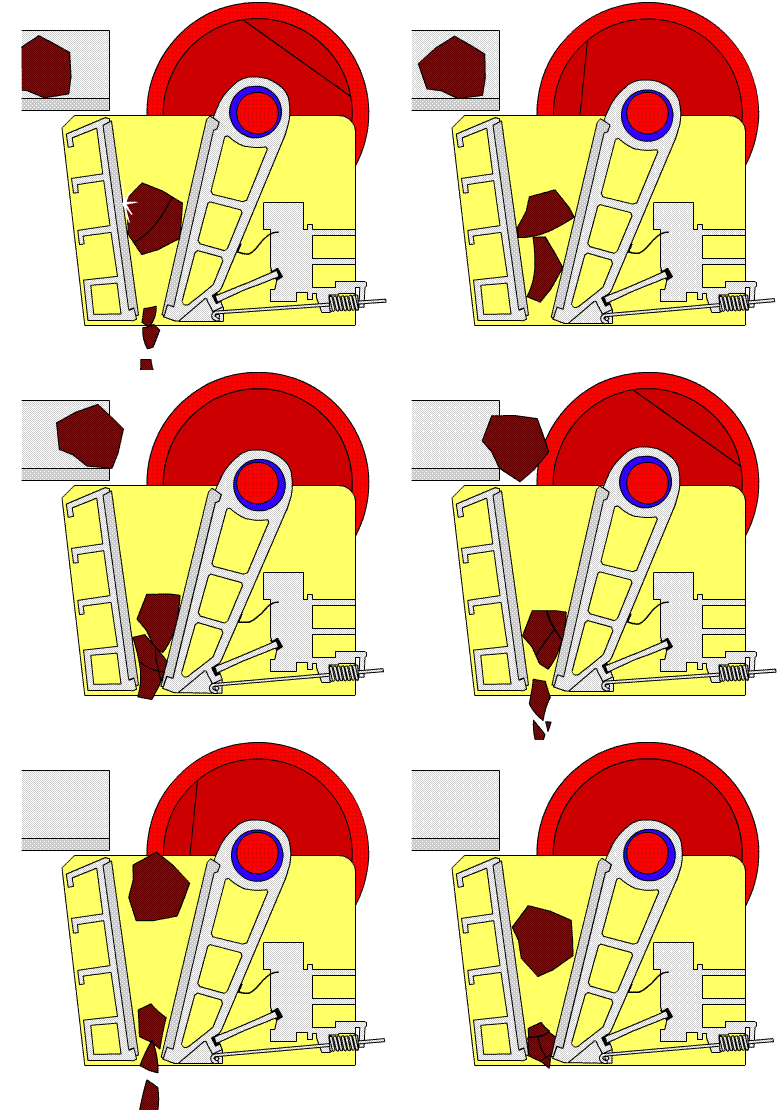


Engineering Mechanics

About the Subject:

Engineering mechanics is the application of mechanics to solve problems involving common engineering elements. The goal of this Engineering Mechanics course is to expose students to problems in mechanics as applied to plausibly real-world scenarios. Problems of particular types are explored in detail in the hopes that students will gain an inductive understanding of the underlying principles at work; students should then be able to recognize problems of this sort in real-world situations and respond accordingly.

Topics to be covered in this Seminar:

Introduction – Units and Dimensions – Laws of Mechanics - Action and reaction forces –stable equilibrium – Moments and Couples – Moment of a force about a point and about an axis - Centroids   and centre of mass– Centroids of lines and  areas - Displacements, Velocity and acceleration, their relationship – Relative motion – Curvilinear motion Newton’s laws of motion - Friction force – Laws of sliding friction - Velocity and acceleration

Time to be planned :

     
1 or 2 days

Kind of program :

       3D based Seminar and Guest Lecture for the Students

Reason for the program :

      Kalam Scientist Team aiming to build young generation Scientist


Cheers,
Kalam Scientist Team
7667668009
7667662428


Basic Electrical and Electronics Engineering

About the Subject:

Electrical and Electronic Engineering is concerned with defining the technologies required for our future needs, including communication, entertainment, energy and healthcare. Electrical and Electronic Engineers are involved in advances in medical technology, e-commerce, mobile telephones, wireless communications, renewable energy and the internet. This degree programme provides students with a broad range of skills relating to all aspects of the design of electronic systems and devices. It combines coursework in different aspects of electrical and electronic engineering, as well as individual and group project work, where students design and build innovative electronic systems.

Topics to be covered in this Seminar:

Ohm’s Law – Kirchoff’s Laws – Steady State Solution of DC Circuits – Introduction to AC Circuits - Operating Principles of Moving Coil and Moving Iron Instruments - Construction, Principle of Operation, Basic Equations and Applications of DC Generators, DC Motors - Characteristics of PN Junction Diode – Zener Effect – Zener Diode and its Characteristics - Binary Number System – Logic Gates – Boolean Algebra – Half and Full Adders – Flip-Flops – Registers and Counters - Types of Signals: Analog and Digital Signals – Modulation and Demodulation

Time to be planned :

     
1 or 2 days

Kind of program :

       3D based Seminar and Guest Lecture for the Students

Reason for the program :

      Kalam Scientist Team aiming to build young generation Scientist


Cheers,
Kalam Scientist Team
7667668009
7667662428